
By the Editorial Team, Travel Immigration Desk | Published: 8 September 2026 | Last updated: 8 September 2026
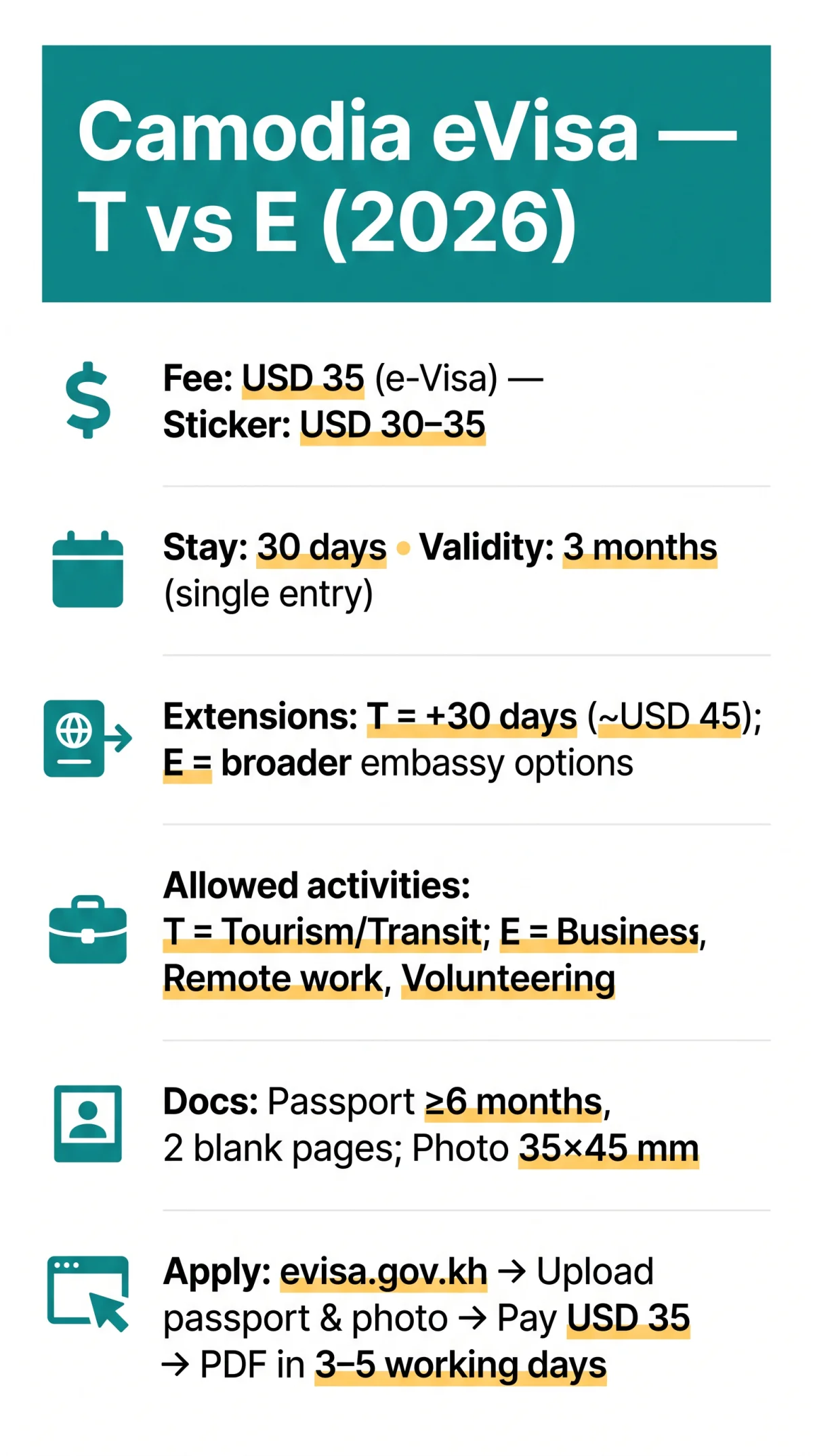
The Cambodia eVisa T class vs E class differ mainly in permitted activities. The T class (Tourist) costs USD 35 for a 30-day single-entry stay for leisure. The E class (Business, also called Ordinary) also costs USD 35 but permits business meetings, conferences, remote work, and volunteer stays, with broader extension options. Both require a passport valid for 6 months, 2 blank pages, and a 35 mm x 45 mm biometric photo. The Cambodia eVisa processing takes 3 to 5 working days via evisa.gov.kh.
What Is the Cambodia eVisa T Class vs E Class?
The T class is a single-entry tourist visa valid for 3 months before departure, permitting a 30-day stay for sightseeing, leisure, and transit only. Paid employment, formal business meetings, and paid volunteer work are prohibited. The T class can be extended once for up to 30 additional days at approximately USD 45 through the Immigration Office in Phnom Penh or Siem Reap.
The E class, also known historically as the Ordinary Visa, covers business meetings, conferences, negotiations, scouting, remote work (under current legal interpretation per the Royal Embassy of Cambodia in London), and volunteer work. The e-Visa version is single entry; the sticker visa obtained at the embassy may support multiple entry. The E class offers broader extension options via embassy-sponsored procedures. For the online Cambodia eVisa, no invitation letter is required; the sticker visa at the embassy requires a guarantee letter from a Cambodian company.
Both Cambodia eVisa classes are available to British passport holders, including BN(O) citizens. In practice, an E-class application submitted via evisa.gov.kh is typically processed within 4 working days, and the extension at the Immigration Office is straightforward once you present your passport, current visa, and passport photo.
Key Differences, Costs, and Eligibility for UK Travellers
The E class offers broader extensions and permits business activities beyond tourism. The Cambodia eVisa T class vs E class share a 3-month validity, single-entry e-Visa format, and a USD 35 fee; both Cambodia eVisa categories are available to UK citizens.
| Attribute | T Class (Tourist) | E Class (Business) |
|---|---|---|
| e-Visa fee | USD 35 | USD 35 |
| Sticker visa fee | USD 30-35 | USD 30-35 |
| Allowable stay | 30 days | 30 days |
| Visa validity | 3 months | 3 months |
| Entry type (e-Visa) | Single entry | Single entry |
| Entry type (sticker) | Single entry | May support multiple entry |
| Extension | Up to 30 days (~USD 45) | Broader embassy-sponsored options |
| Permitted activities | Tourism, sightseeing, transit | Business, conferences, remote work, volunteer |
| Extra documents (e-Visa) | None beyond standard | None beyond standard |
| Extra documents (sticker) | None | Guarantee letter from Cambodian company |
| UK eligibility | Yes | Yes |
When to Choose T Class vs E Class: Practical Scenarios
The Cambodia eVisa T class covers tourism and transit only; the E class covers business meetings, conferences, negotiations, remote work, and volunteering.
- Angkor Wat tourist: A two-week visitor needs the T class, allowing a 30-day stay, extendable by up to 30 additional days.
- Conference attendee: A consultant in Phnom Penh requires the E class for business meetings.
- Digital nomad: A remote worker staying multiple months needs the E class, which permits remote work under current legal interpretation.
- NGO volunteer: A charity worker must choose the E class, which explicitly permits volunteer work.
- Trade delegation: A group attending a trade fair requires the E class for negotiations.
- Backpacker transiting: A 10-day transit through Cambodia needs only the T class.
- Yoga retreat instructor: An extended retreat requires the E class for longer stays.
Remote work on a T class remains a legal grey area for the Cambodia eVisa T class vs E class decision. The Royal Embassy of Cambodia in London (tel. 020 8451 7850, [email protected]) can confirm whether your specific activity requires the E class.
Application Process, Extensions, and Compliance

Apply at evisa.gov.kh: choose T or E, upload passport scan + 35 mm x 45 mm photo, pay USD 35 by credit or debit card, receive the PDF within 3 to 5 working days. No invitation letter is needed for either class when applying online for the Cambodia eVisa.
Visit evisa.gov.kh and select visa category T or E
Complete the online form
With passport data, entry date, and port of entry.
Upload a passport scan and a 35 mm x 45 mm photo
Pay USD 35 by credit or debit card
Receive the e-Visa PDF within 3 to 5 working days
Alternatively, UK travellers can obtain a sticker visa in person at the Royal Embassy of Cambodia in London (processing: 3 working days, Mon-Fri 09:30-12:00 and 14:00-17:00) or by post (5 working days; use certified mail with tracking). Visa on Arrival is available at select ports as a backup but involves queues on arrival and is not available at all crossings.
T class holders may extend once for 30 additional days at approximately USD 45 through the Immigration Office in Phnom Penh or Siem Reap (processing: 1 to 3 working days). E class holders access broader extension options via embassy-sponsored procedures. Overstaying incurs daily fines from the Immigration Office, detention risk at departure, and negative impact on future visa applications. Using the wrong Cambodia eVisa type can lead to deportation and future entry complications.
FAQ: Cambodia eVisa T Class vs E Class
What is the difference between Cambodia eVisa T class and E class?
The T class is a tourist visa for leisure, sightseeing, and transit only. The E class (Ordinary Visa) permits business meetings, conferences, remote work, and volunteer stays. Both cost USD 35 and allow a 30-day single-entry stay; the E class offers broader extensions.
How much does a Cambodia eVisa cost in 2026?
In 2026, both T class and E class eVisas cost USD 35 (~£28), standardised since January 2025. The sticker visa at the embassy costs USD 30-35. Extensions cost approximately USD 45 for the initial extension.
Can I work remotely in Cambodia on a tourist T class eVisa?
No. T class prohibits employment and paid volunteer work. Remote work requires the E class. If in doubt, consult the Royal Embassy of Cambodia in London (020 8451 7850).
How long can I stay in Cambodia with an eVisa?
Both T and E class eVisas allow a 30-day stay upon entry, with 3-month validity before departure. Both are single-entry only.
Can I extend my Cambodia eVisa?
Yes. The T class can be extended once for up to 30 additional days (~USD 45). The E class offers broader embassy-sponsored extensions. Extensions are processed at the Immigration Office in Phnom Penh or Siem Reap within 1 to 3 working days.
What documents do I need for a Cambodia eVisa?
A passport valid for at least 6 months with 2 blank pages, and a biometric photo measuring 35 mm x 45 mm. No invitation letter is required for the online e-Visa. The E class sticker visa at the embassy requires a guarantee letter from a Cambodian company.
Which ports of entry accept the Cambodia eVisa?
Phnom Penh International Airport, Siem Reap International Airport, Bavet land border, and Poipet land border, plus select additional crossings. Verify your entry point before applying.
Is the Cambodia eVisa available to UK citizens?
Yes, both T and E class eVisas are available for British passport holders, including BN(O) citizens. Apply via evisa.gov.kh or obtain a sticker visa from the Royal Embassy of Cambodia in London, 64 Brondesbury Park, Willesden Green, London NW6 7AT (tel. 020 8451 7850, Mon-Fri 09:30-12:00 and 14:00-17:00).
Sources: evisa.gov.kh (E-Visa Office of the Ministry of Foreign Affairs and International Cooperation of Cambodia); Royal Embassy of Cambodia in London (cambodiaembassyuk.org, 64 Brondesbury Park, Willesden Green, London NW6 7AT). Visa policies can change without notice; always verify current requirements with the Royal Embassy of Cambodia in London or the evisa.gov.kh portal before applying.